
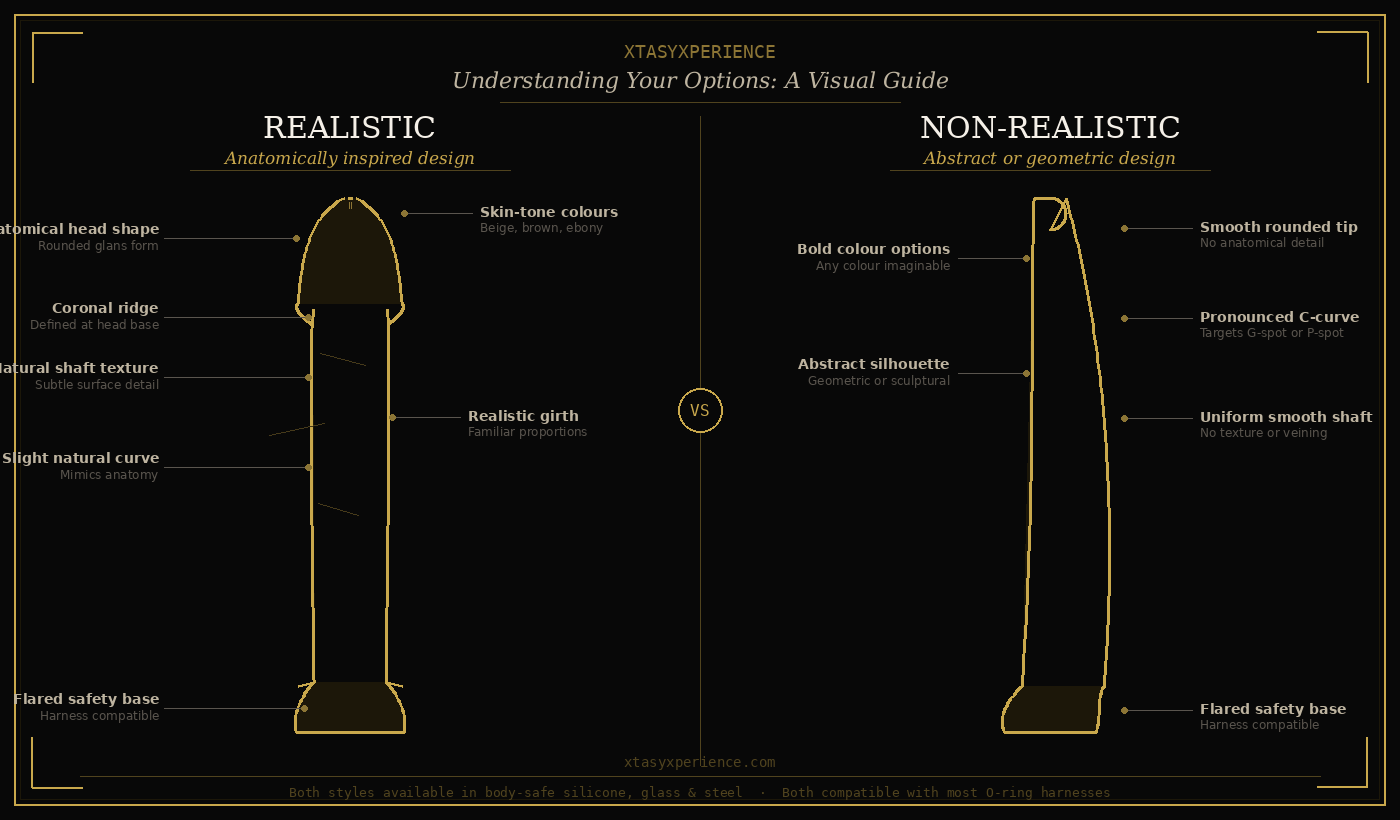
The realistic vs. non-realistic choice isn't about aesthetics — it's about how each design creates a different sensation experience. Here's what actually matters for your decision.
Most guides frame the realistic versus non-realistic dildo question as a matter of personal taste — some people prefer the visual context of a realistic design; others find abstract shapes more appealing or more comfortable to own. That framing is true as far as it goes. But it leaves out the more useful part of the answer, which is that realistic and non-realistic dildos create meaningfully different physical experiences — and that difference, not the aesthetic, is usually what determines which one serves you better.
This post covers both sides of that distinction: what each design category does physically, and what that means for your choice. The complete dildo guide covers the full decision framework including size and material — this is the post for the specific question of design and what it produces.
What a Realistic Dildo Actually Does Physically
A realistic dildo — designed to approximate the appearance of a penis — has several physical features that directly affect the sensation it delivers: a defined glans (head), surface veining, and often a graduated shaft that's slightly wider at the base than at the tip.
The defined head
The pronounced ridge where the head meets the shaft creates a specific pressure sensation during insertion and during in-and-out movement. As the toy moves, this ridge drags against the walls of the vaginal canal, producing a variable sensation that changes with each stroke rather than staying constant. For many people, this ridge provides the most stimulating moment in each movement cycle — it's functionally similar to why penetrative sex with a partner tends to feel most intense at the moment of withdrawal and re-entry rather than during sustained stillness.
Surface texture and veining
The textured surface of a realistic dildo creates friction during movement that a smooth surface doesn't. This friction increases the stimulation of the vaginal walls — particularly during movement — and for many people this additional stimulation is significant enough to make realistic designs markedly more pleasurable than smooth ones. For others, particularly those who tend toward sensitivity rather than needing intensity, the additional texture can feel like too much — crossing from pleasurable stimulation into overstimulation. This is body-specific and not predictable without direct experience.
The psychological dimension
For some people, the visual resemblance of a realistic dildo is itself part of what makes the experience more engaging — it provides a psychological context that contributes to arousal and immersion. For others, a non-realistic design is preferable precisely because it removes that context and allows the experience to be entirely about sensation without the visual associations. Both are legitimate. The point is that the psychological component is part of the functional picture, not separate from it.
Who realistic dildos tend to suit
People who enjoy penetrative stimulation from the full range of movement — especially the sensation of entry and withdrawal. Those who find textural variation more pleasurable than smooth pressure. People for whom the visual context of a realistic design adds to the experience rather than distracting from it.
What a Non-Realistic Dildo Actually Does Physically
Non-realistic dildos — ranging from smooth, featureless cylinders to dramatically contoured abstract shapes with ridges, tapers, and geometric curves — are designed with sensation mechanics as the primary consideration rather than visual mimicry. Each design choice in the non-realistic category is making a specific functional argument: this curve targets a specific internal structure; this ridge creates a specific pressure point; this taper allows for a specific angle of use.
Clean, consistent pressure
A smooth, non-realistic dildo delivers even, unvarying pressure across the entire surface it contacts. There's no ridge, no texture variation, no point where friction suddenly increases. For people who prefer sustained, consistent stimulation over variable sensation, this consistency is what makes smooth designs more pleasurable than textured ones — the signal is clean, predictable, and easier to build toward orgasm with because nothing interrupts the accumulation.
Precision targeting — the curved and contoured designs
The most common functional advantage of non-realistic designs is their ability to target specific anatomy with precision that a straight, realistic shaft can't match. A steeply curved dildo — sometimes called a G-spot dildo or an internal wand — positions its tip against the anterior wall with each movement in a way that a straight realistic design requires a very specific body position to replicate. Ridges placed at calculated intervals can create a progression of pressure points as the toy moves. Bulbous heads on otherwise slim shafts create intense focused pressure at a single point.
These designs are frequently the preference of experienced users who know exactly what internal anatomy they want to stimulate and want a toy engineered to do precisely that — rather than one that approximates general stimulation across the full canal. The size considerations for these designs interact with the shape in ways that the size guide covers — particularly for curved designs, where the insertable length measurement behaves differently than it does on a straight shaft. The dildo size guide covers this nuance if you're in the process of deciding.
Who non-realistic dildos tend to suit
People who prefer consistent, sustained stimulation over variable friction. Those who are specifically interested in G-spot or anterior wall targeting. Users who find textured surfaces overstimulating. People for whom a non-representational visual aesthetic is preferable. Experienced users who want precision over general stimulation.
The Practical Decision Framework
Two questions resolve this choice for most people, and they work better than any aesthetic preference as starting points.
What kind of stimulation do you respond to most strongly?
If you find that the moment of penetration — the entry sensation — and the feeling of in-and-out movement are what you respond to most, a realistic design with a defined head will likely serve you well. The ridge and the movement variability are what produce those specific sensations most strongly.
If you find that sustained pressure against a specific internal location — particularly the anterior wall — is what produces the most pleasure, a curved non-realistic design will likely target that more reliably than any realistic shaft. The geometry is engineered for it.
If you're genuinely uncertain, start with a smooth, lightly curved non-realistic design — it provides the most useful first-experience information because its sensation profile is consistent and legible. You'll know fairly quickly whether you want more texture and movement variation (realistic) or more precision and targeting (contoured non-realistic).
Are you planning harness use?
For harness use, non-realistic designs with a flat, suction-cup compatible base tend to sit more securely in an O-ring than textured realistic designs where the veining can affect the fit. This is worth knowing before you buy if strap-on use is part of what you're planning. How to use a dildo with a harness covers base specifications and harness compatibility in full.
The Shared Non-Negotiable
The Material Standard Neither Category Escapes
Regardless of which design direction you choose, material is the specification that doesn't vary. Body-safe silicone is the standard for most realistic and non-realistic dildos in the quality tier. Glass and stainless steel are excellent choices for non-realistic designs — particularly the precision-curved designs, where the rigidity of glass or steel enhances the targeted pressure that makes the shape work. Avoid porous materials in either category for penetrative use.
One material note specific to realistic designs: dual-density silicone — a firm inner core surrounded by a softer outer layer — is the closest analogue to the feel of biological penetration. It's the material specification that makes a realistic design most closely replicate what it's visually representing, and it's worth looking for specifically if that sensory correspondence matters to you. Browse our dildos collection and filter by design type to see what's available in both categories to our material standard.
Find Your Design
Realistic or non-realistic — the right answer is the one that matches how your body responds to stimulation, not the one that looks most impressive. Explore our dildos collection with your sensation preference as the filter. Both design categories are there, both held to the same material standard, and both specified in enough detail to make an informed comparison.